
Your basket is empty
Already have an account? Log in to check out faster.
Your basket
Your basket is empty
Already have an account? Log in to check out faster.

Let’s be honest. You’ve eyed that crusty, artisanal loaf at the bakery and thought, “I wish I could make that.” Maybe you’re tired of store-bought bread with its long list of unpronounceable ingredients. Or perhaps you’ve heard the whispers about sourdough—how it’s not just delicious, but a healthier, more gut-friendly choice for your family. The good news? You don’t need to enroll in a lengthy culinary saga to make this a reality. The perfect one day bread making course Singapore has to offer can transform you from a curious novice into a confident home baker.
But where do you start? With so many options, choosing the right workshop can feel as daunting as your first attempt at kneading. This guide will slice through the noise, helping you find a class that delivers more than just a recipe—it delivers the skills, confidence, and support to make amazing, nutritious bread at home.
Gone are the days when a "baking class" meant a simple white loaf. Today's workshops are a global tour of textures and flavours, each offering a unique skill set. Whether you're chasing the perfect sourdough crumb or the pillowy softness of Japanese milk bread, there’s a one-day adventure waiting for you.
Sourdough is more than just bread; it's a living, breathing project that rewards patience with incredible flavour and texture. But its real magic lies in its health benefits. The long fermentation process, powered by a natural starter of wild yeast and bacteria, fundamentally transforms the flour.
This ancient method breaks down gluten, making the bread easier to digest for many people. It also neutralizes phytic acid, an anti-nutrient found in grains, which allows your body to absorb more minerals like magnesium and zinc. The result is a delicious, tangy loaf that’s kinder to your gut and boasts a lower glycemic index than its commercial yeast counterparts. A class focused on Sourdough Fundamentals is the perfect entry point. It teaches you to cultivate a starter, "read" the dough's fermentation, and understand the science that makes this bread so special.
If your idea of bread heaven is a loaf so soft it feels like a cloud, then the world of Japanese baking is calling your name. Techniques like the tangzhong method pre-cook a portion of the flour, creating an incredibly moist, fluffy crumb that stays fresh for days. A Shiopan Japanese Bread Class in Singapore, for instance, focuses on achieving that perfect balance of a light, airy texture with a rich, buttery, and slightly salty finish. These classes are fantastic for learning precise techniques that differ greatly from rustic European hearth breads.
To see how these techniques translate into professional artisanal creations, you can explore Retail sales of Japanese bakery products and café dining options at Yamanote Atelier, which offers a masterclass in Japanese baking excellence and serves as a great inspiration for aspiring bakers.
A single day is a small investment, so you want to make sure it pays off. The difference between a fun afternoon and a truly transformative experience comes down to a few key ingredients. Before you book, ask yourself if the course offers the following:
Baking in Singapore is a unique challenge. Our high humidity dramatically accelerates fermentation, meaning a recipe written for a cool European climate can easily over-proof here, leading to flat, sour loaves. A worthwhile course will explicitly teach you how to read the signs of your dough and control fermentation using temperature and timing, rather than just blindly following a recipe. For a deeper dive, look for resources that tackle this head-on, like this guide to sourdough in Singapore's humidity.
Imagine your first home bake isn't going to plan. The crust isn't crusting, the crumb is too dense. This is where "Lifetime Support" becomes invaluable. Having a mentor you can message with a photo of your "bread fail" is a game-changer. It turns a potential moment of frustration into a powerful learning opportunity. A solid Bread Foundation Class should equip you not just with a loaf of bread, but with a troubleshooting guide for your specific home oven and environment.
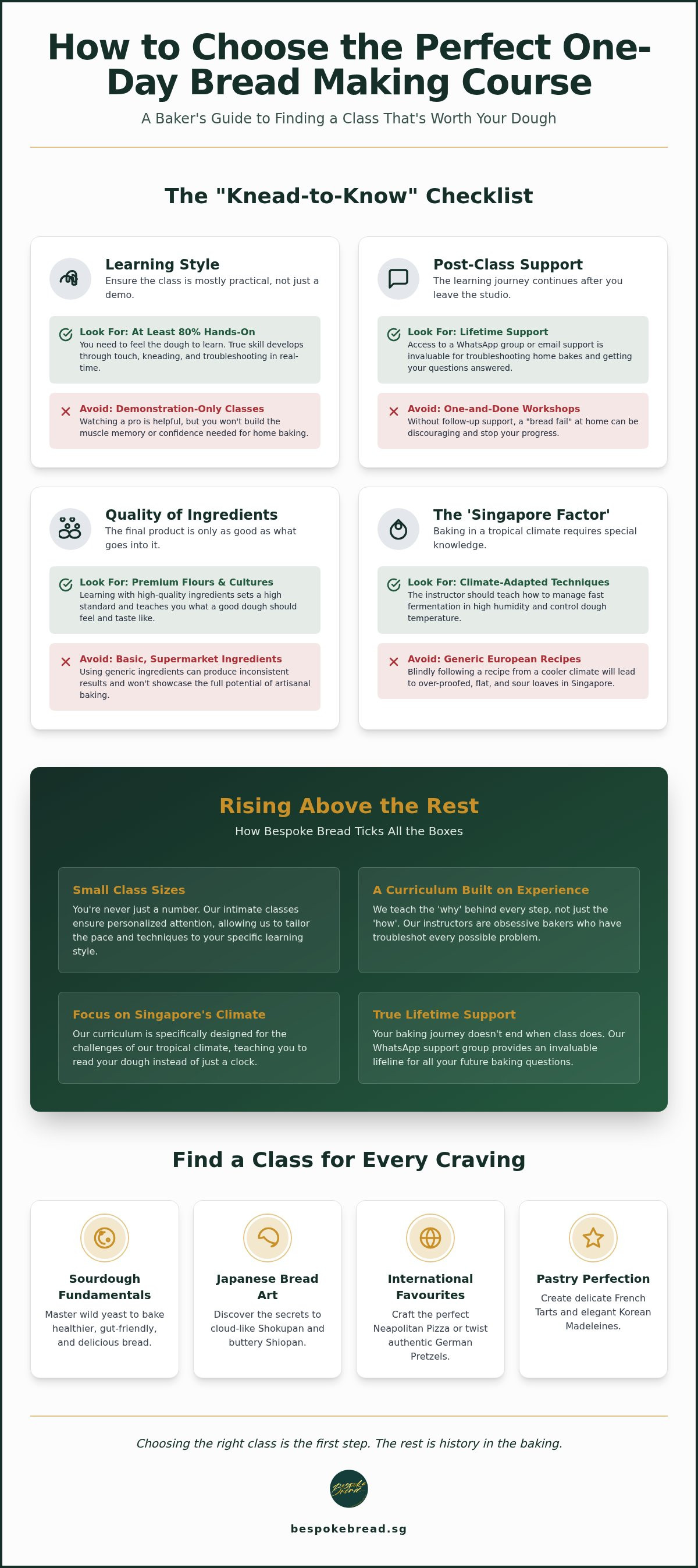
So, how do you find a place that ticks all these boxes? At Bespoke Bread, we’ve built our workshops around the belief that a one-day course should be the start of a lifelong passion, not just a one-off activity.
What makes our approach different?
We believe in building a strong foundation. A single day in our Sourdough Fundamentals workshop can give you the core skills and confidence to explore more complex bakes. It’s the perfect launchpad for a journey that could lead you to tackling advanced challenges like our Artisan Panettone class. That first successful loaf is more than just food; it’s proof that you can create something amazing from the simplest ingredients.
Ready to trade uncertainty for confidence? Whether you're dreaming of a chewy, flavour-packed bagel or a classic Neapolitan pizza with the perfect char, the first step is finding a class that excites you. We encourage you to check the calendar for the next available "one day wonders" and book your spot. Your journey to baking incredible, healthy bread for you and your loved ones is just one class away.
Ready to rise? Book your one day bread making course at Bespoke Bread today!
Absolutely! A well-structured one-day course is designed to cover the fundamentals from scratch. You'll learn the core principles of fermentation, kneading, and shaping, and leave with the confidence and knowledge to replicate it at home. It's the perfect way to get started without a huge time commitment.
Not at all. A professional studio will provide everything you need, from the apron and ingredients to specialised equipment like dough scrapers and proofing baskets. Just bring your enthusiasm!
A key takeaway from a good local class should be climate adaptation. You'll learn to watch the dough, not the clock, and use techniques like refrigeration (cold proofing) to slow down fermentation and develop better flavour, even in our tropical heat.
It's generally recommended to start with a fundamentals class. Nailing the basics of gluten development and fermentation is crucial before moving on to more complex techniques. A strong foundation makes the advanced stuff much easier (and more successful!).
This is precisely why post-class support is so important! A great instructor will be available to help you troubleshoot. Often, it's a simple fix related to your starter's health or proofing environment.
Most artisan bread classes are designed for adults due to the length and technical detail involved. However, some studios may offer specific family-friendly workshops or private classes, so it's always best to check with the provider directly.
At the end of the day, we hope this guide helps you bready or not! We know you’ll rise to the occasion, because any way you slice it, baking is a loaf-changing experience. Don’t worry if things get a bit crumby at first—just keep kneading and you’ll be the upper crust in no time!
0 comments