
Your basket is empty
Already have an account? Log in to check out faster.
Your basket
Your basket is empty
Already have an account? Log in to check out faster.

The best beginner bread workshop isn’t necessarily the one promising the fanciest loaf. It’s the one that helps you understand your dough when you’re back in your own kitchen. When comparing a bread making workshop for beginners Singapore learners can attend, look for hands-on practice, clear explanations and time to ask questions, not just a demonstration of kneading.
You don’t need baking experience to get started, but you do need guidance and room to learn by doing. This guide covers how to compare workshop formats, class topics and take-home support. Bespoke Bread’s one-day, hands-on Bread Foundation Class for Beginners introduces core skills, while the Sourdough Baking Class - Fundamentals focuses on sourdough. Both offer expert instruction, troubleshooting tips and support for home bakers, so you can keep learning after class and give your first loaf a better chance to rise to the occasion.
A useful beginner workshop is guided practice, not a test of your baking instincts. Expect an introduction to foundational skills such as handling dough, understanding fermentation and shaping loaves. A bread making workshop for beginners Singapore learners choose should make these steps approachable, with an instructor demonstrating techniques and helping you practise them. Notice whether explanations connect what you see and feel in the dough with the result you want.
Bread has a rich range of types and traditions, so there’s more to learn than one recipe. The History and Science of Bread offers a broad introduction to its preparation and cultural background. In class, the focus is practical: feeling how dough changes as it is handled and fermented, then seeing how shaping affects the loaf. Bespoke Bread’s Bread Foundation Class for Beginners is a starting point for learners who want to build core bread-making skills.
A hands-on workshop is different from professional certification or long-term training. It gives you a structured introduction and a chance to practise, rather than promising mastery in one sitting. Bespoke Bread also offers other baking formats, including a French pastry tarts class in Singapore, for learners curious about a different craft.
No advanced knowledge is needed for a beginner-focused class. Demonstrations break unfamiliar steps into manageable parts, then guided practice gives you a chance to try them yourself. It can take time to judge dough texture or shape a loaf evenly, and that’s normal. Confidence grows with practice, and every loaf can turn out a little differently.
Bring your questions and treat missteps as part of the lesson. If the dough feels stickier or firmer than expected, noticing that difference is useful practice, not a reason to panic. A little curiosity goes a long way, and your first bake is a chance to get the dough rolling.
A tempting menu of finished loaves is only part of the picture. To compare a bread making workshop for beginners Singapore bakers can join, focus on what you’ll actually practise. Will you handle the dough yourself, or mainly watch? Does the instructor explain the purpose of each step? Can you ask questions when the dough behaves differently from what you expected?
Useful lessons cover more than following a recipe. Look for clear guidance in foundational skills such as mixing, fermentation and shaping, as well as practical troubleshooting that helps you think through what may have gone wrong. For example, a class should help you pay attention to the dough’s texture and how it changes, rather than relying only on a timer or memorised instructions. Also consider what is included and what support continues after class. Bespoke Bread’s one-day, hands-on classes include materials and ingredients, expert instruction, troubleshooting tips and lifetime support for home baking.
Want broad foundations before choosing a speciality? Bespoke Bread’s Bread Foundation Class is a relevant starting point. If sourdough is the loaf you’re keen to tackle, the Sourdough Baking Class - Fundamentals focuses on that path. Choose based on what you most want to bake, then consider how the skills and support can help you continue at home. That’s a recipe for a more confident start.
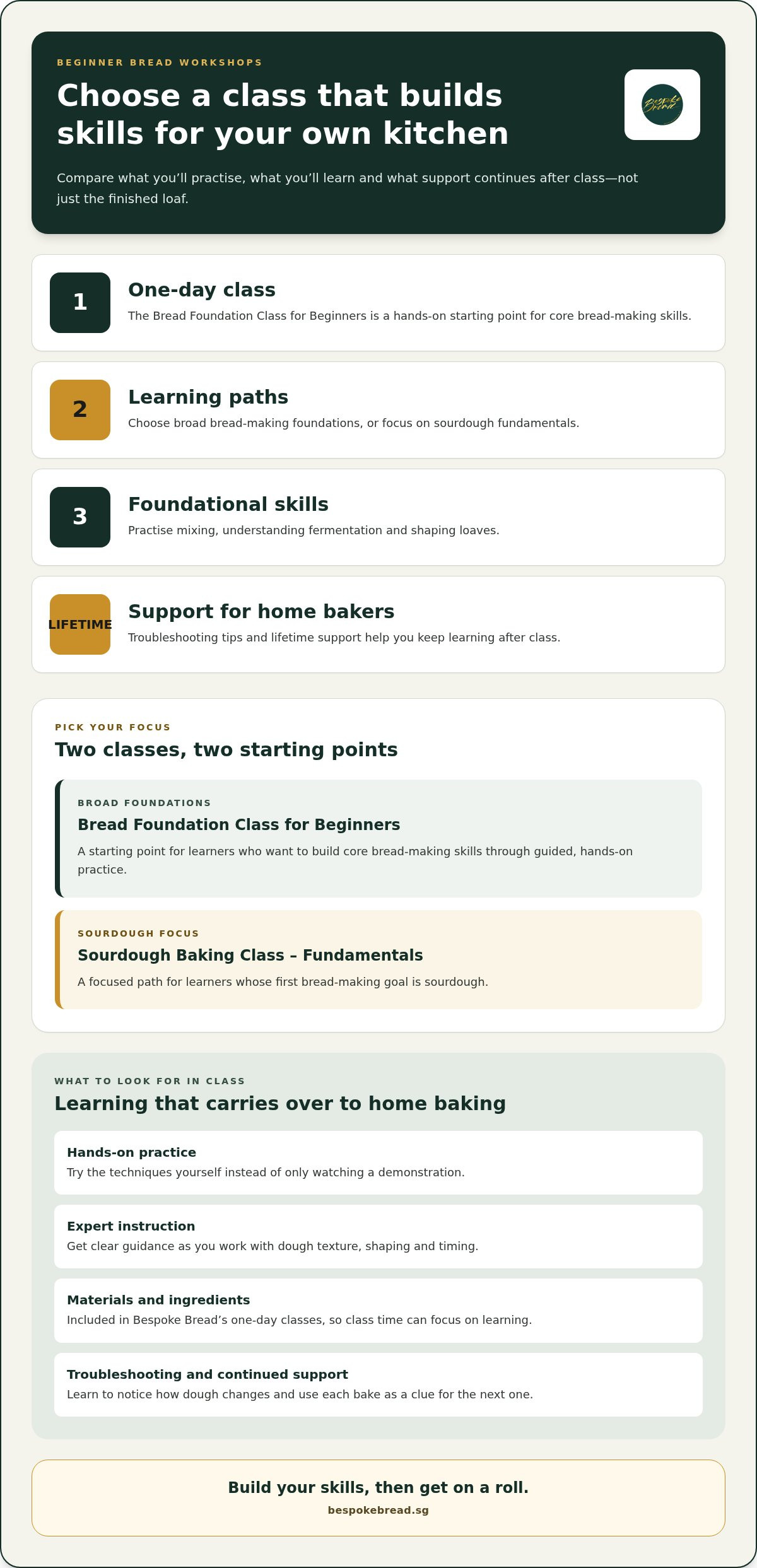
A good class should help you move from following instructions to making sense of your own dough at home. Keep your choice simple: decide what you want to bake, look for guided practice that matches that goal, then consider what support you’ll have when a loaf doesn’t turn out as expected. That’s a practical way to choose a bread making workshop for beginners Singapore home bakers can build on.
Bespoke Bread’s one-day classes include materials and ingredients, so you can focus on learning in class. Expert instruction and troubleshooting tips help you apply techniques later, while lifetime support gives home bakers ongoing help as they practise. Loaves can behave differently from one bake to the next, but knowing what to observe makes it easier to learn from the result instead of guessing.
Troubleshooting tips can help you think through common challenges, such as dough that feels difficult to handle or a loaf that doesn’t rise as expected. Rather than treating a bake that misses the mark as a failure, use it as a clue for your next attempt. Lifetime support for home bakers means the learning doesn’t have to stop when class ends.
Explore Bespoke Bread’s baking classes to find a hands-on learning option, or try a different baking craft with the French pastry tarts class in Singapore. However your baking journey begins, keep practising and let your confidence rise, one bake at a time. That’s how you get on a roll!
The right bread making workshop for beginners Singapore learners choose starts with their goal: build broad bread-making foundations or focus on a favourite style. Look beyond the finished loaf and compare how much guided practice you’ll get, whether you can troubleshoot as you learn and what support continues at home.
Bespoke Bread’s expert-led, hands-on one-day classes include materials and ingredients, plus troubleshooting tips and lifetime support for home bakers. You can focus on learning in class, then keep building confidence as you practise in your own kitchen. Every bake is a chance to learn, even when the dough has other plans.
Explore Bespoke Bread’s beginner baking classes and find a starting point that suits you. Your first loaf doesn’t need to be perfect; it just needs to get you rolling.
No, a beginner-focused workshop is designed to introduce core techniques without expecting advanced baking knowledge. You’ll learn through expert guidance and hands-on practice, and it’s normal to need time to get comfortable handling dough or shaping a loaf. Each bake can turn out differently, so treat early attempts as useful practice rather than a pass-or-fail test.
A one-day workshop can introduce practical bread-making skills through expert-led, hands-on instruction. Depending on the class subject, you may practise making sourdough, artisan breads, pizza or other baked items. Bespoke Bread classes include materials and ingredients, plus troubleshooting tips and lifetime support for home bakers. Choose a class that matches what you want to bake, since the techniques and outcomes vary by subject.
Choose a foundation class if you want a broader introduction to bread-making basics; pick sourdough fundamentals if sourdough is your main goal. Bespoke Bread’s Bread Foundation Class for Beginners offers a starting point for foundational learning, while its Sourdough Baking Class - Fundamentals focuses on sourdough. Either way, consider which subject you’re most excited to keep practising at home.
No, “beginner” describes the intended learner level, while SkillsFuture eligibility is a separate course status. A workshop being suitable for first-timers doesn’t automatically mean it’s SkillsFuture-eligible or subsidised. Check the relevant official course information for eligibility before relying on credits or subsidies. Bespoke Bread’s classes provide hands-on baking instruction, and funding eligibility depends on the course’s official status.
0 comments