

Your basket is empty
Already have an account? Log in to check out faster.
Your basket
Your basket is empty
Already have an account? Log in to check out faster.

A baking class can be worth it when expert guidance, hands-on practice and access to tools help you learn more than trial and error at home. Whether a baking class is worth it depends on what you want to make, which skills you’ll gain and how the fee fits your budget. The value is not just the finished loaf or pastry; it’s learning what to do when the dough behaves unexpectedly.
It’s fair to weigh the price against what you’ll learn and whether you’ll use those skills again. This guide looks at how professional tools, expert feedback and baking fundamentals can shape that value, plus the practical factors to consider when comparing class costs in Singapore. No need to be a whisk-taker: a little clarity can help you choose a class that suits your goals.
A stand mixer, bench scraper and piping bag each behave differently in a busy kitchen. In a baking class, you can handle these tools under a professional baker’s supervision, then get immediate pointers on mixing or shaping. If dough feels too sticky or a filling looks loose, an instructor can help troubleshoot the recipe and discuss ingredient substitutions before the bake goes off course.
Online tutorials are useful for pausing, rewinding and following recipes at your own pace. But they can’t watch your dough develop or respond to what’s happening in your bowl. A live class adds real-time feedback: an instructor can demonstrate how dough should feel and guide your next step. That makes hands-on learning especially useful when a recipe leaves you unsure.
Expert guidance also gives you room to practise flavour and presentation. Try adding citrus zest to a tart filling, for example, or pipe a neat finish instead of hiding uneven edges. A shared kitchen makes baking social, too: you can compare results, exchange ideas and enjoy what you make together. The value lies in building skills and getting practical feedback, not just tasting your creation.
A short class offers a hands-on kitchen experience, while pastry school usually represents a broader learning commitment. Choose based on whether you want focused practice with a recipe or deeper, ongoing study. In Singapore, class arrangements determine whether ingredients and equipment are provided and whether you take home your bake; these details should be clear in the class information. That distinction helps you judge what the fee covers without assuming every session includes the same things.
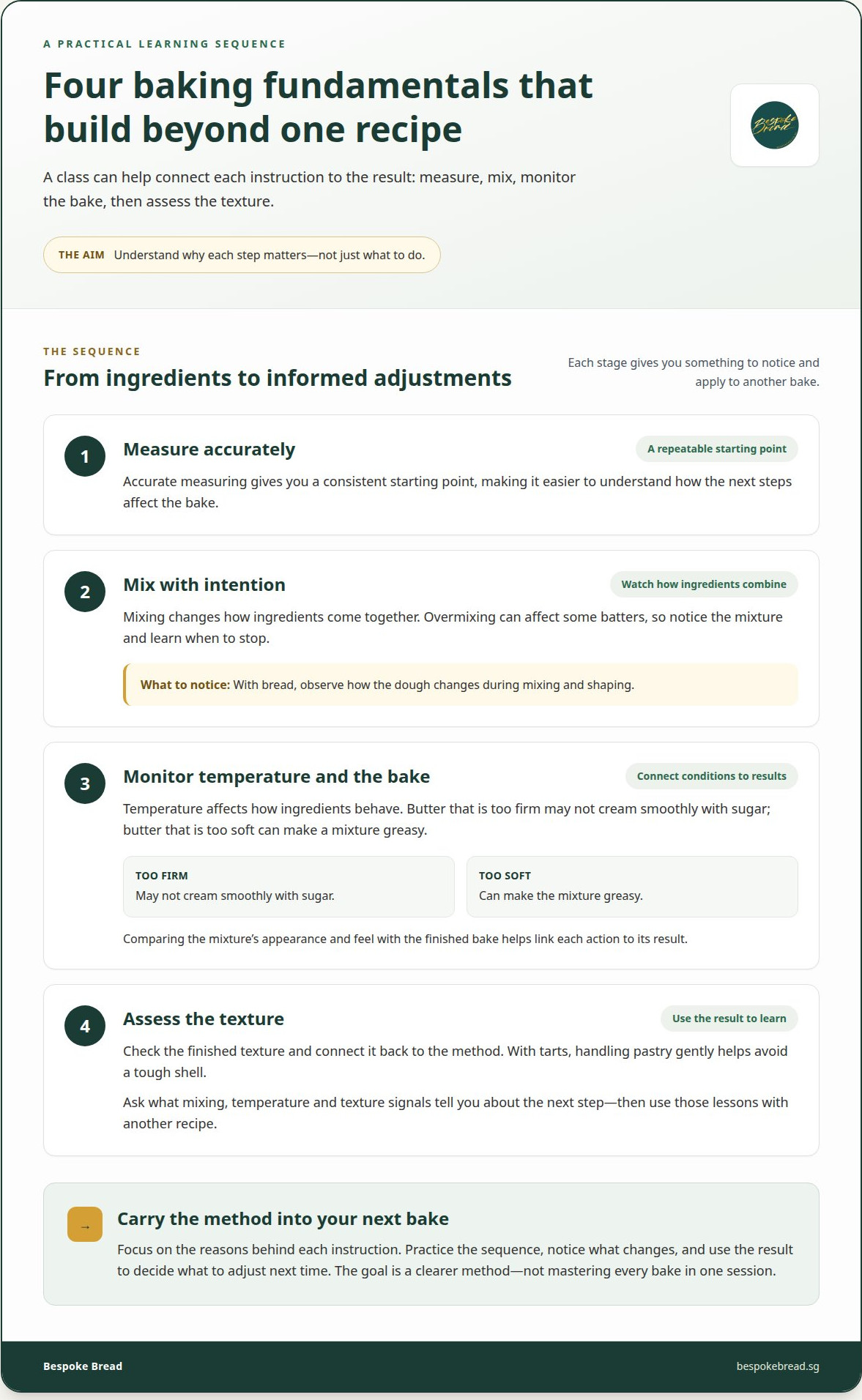
Good baking skills come from understanding what each step does, not just copying a recipe. Accurate measuring gives you a repeatable starting point, while mixing changes how ingredients combine. An instructor can explain how overmixing affects some batters and show you when to stop. That knowledge applies to everything from simple cakes to pastries with delicate mixtures.
Temperature control is another core technique. Butter that’s too firm may not cream smoothly with sugar, while butter that’s too soft can make a mixture greasy. A baking class can show how butter and sugar combine to create a tender, fluffy crumb. Comparing the mixture’s appearance and feel with the finished bake helps connect each action to its result.
Structured learning also lets you practise techniques in a useful sequence: measure, mix as directed, monitor the bake, then assess the texture. With bread, notice how dough changes during mixing and shaping. With tarts, handle the pastry gently to avoid a tough shell. Each practice builds skills you can adapt instead of relying on guesswork.
To get the most from a class, focus on the reasons behind each instruction. Ask how mixing changes the result, how temperature affects it and what texture signals the next step. Then apply those lessons to another recipe at home. The goal isn’t to master every bake in one session; it’s to leave with a clearer method for identifying what worked and what to adjust next time.
There isn’t one standard price for every baking class in Singapore. The price depends on the case and is given after a quote request; relevant cost factors include the recipe, ingredient choices, class format and what the fee covers. A hands-on dessert session, for example, may involve different materials and preparation from a bread lesson. Ask yourself, “Is a baking class worth it for the bake you want to learn?”
To compare value, look beyond the finished bake. A fee may cover an instructor, ingredients, equipment use or a takeaway, but inclusions vary by class. Consider the skills you’ll practise and whether they’ll help with recipes at home. Friends sharing a session might also value the social experience, while someone learning a specific technique may prioritise guided practice.
Cancellation and refund terms aren’t universal across Singapore classes. Booking terms can explain the cancellation window, refund eligibility and whether rescheduling is possible, so read those details before committing.
When comparing classes, consider the recipe, level of instruction, included materials and format. For friends planning a shared outing, ask: “Is a baking class worth it as an experience as well as a lesson?” Bakers focused on a particular loaf may value a specialised session; a group celebrating together may care more about the shared activity.
For example, review the details of a sourdough fundamentals class to see how its focus aligns with your goals. Matching the class to what you want to learn makes the fee easier to assess.
Bespoke Bread’s Sourdough Baking Class - Fundamentals is a practical choice if you want guided experience making sourdough. It’s suitable for beginners who want to learn how the dough feels and how the process works, with an expert to guide them. Hands-on instruction and troubleshooting tips make each stage easier to understand, while lifetime support helps home bakers beyond the class.
If sourdough isn’t what you want to bake, Bespoke Bread also offers classes in shiopan, pizza making and French pastry tarts. Choose a subject that matches what you’re keen to make, then consider whether guided practice suits your learning goals. Ready to roll up your sleeves? Explore Bespoke Bread’s classes and book the one that gets your baking journey rising.
Choose a bake you’re genuinely excited to make, then think about what would help you enjoy the process at home. Perhaps you want to try a new dough, shape pastries with more confidence or make something delicious to share. That personal goal is a useful guide when deciding whether a baking class is worth it. You don’t need a grand baking plan; one curious step can be enough to get your hands floury and your ideas rising.
Ready to explore a class that matches your interests? Contact Bespoke Bread about classes and take the next step at your own pace. There’s plenty of room to learn, experiment and enjoy the occasional wonky bake along the way. Give your baking plans a whisk of confidence, and see where they rise.
Assess credibility through instructor recognition, clear course details and practical teaching. Bespoke Bread instructor Chef Karen Ng won Best Chocolate Panettone in Asia at Coppa del Mondo in 2025. That achievement offers a concrete point of reference, while the class format and stated learning outcomes help you judge whether the teaching suits your goals.
Expect to learn skills related to the bake you choose, rather than follow one syllabus for every class. Bespoke Bread offers classes in sourdough, pizza, artisan breads and pastries, with expert guidance and troubleshooting tips. A sourdough-focused session, for example, is a better fit if you want to practise bread making than a class centred on pizza.
Baking classes in Singapore are priced per session, and the amount depends on the specific class. Compare the recipe focus, session format and what’s included, such as ingredients, tools and learning materials. This helps you weigh the cost against what you’ll practise and take away, rather than judging a class by price alone.
Yes. Bespoke Bread offers beginner-friendly classes, and no prior experience is required. A first-time baker can choose a fundamentals-focused session and learn with guided instruction instead of needing to arrive with polished skills. If you’ve baked before, a class centred on a new style, such as pizza or Japanese bread, can offer a fresh challenge.
You can develop practical skills for the bake you choose, including following a recipe, handling dough and spotting when something needs adjusting. A sourdough class lets you practise working with a starter, while a pastry session focuses on different techniques. Troubleshooting tips also help you think through what to adjust when a bake doesn’t go to plan.
0 comments