

Your basket is empty
Already have an account? Log in to check out faster.
Your basket
Your basket is empty
Already have an account? Log in to check out faster.

Have you ever spent your entire Sunday nurturing a dough, only to watch it melt into a sad, sticky puddle the second you try to shape it? It's a "knead-to-know" situation that every local baker faces, and it's exactly why sourdough troubleshooting Singapore is its own unique craft. Our sweltering humidity can turn a promising loaf into a flat "frisbee" faster than you can say "kaya toast." Whether your starter smells like nail polish remover or your bread refuses to rise in the oven, the heat is likely playing tricks on your fermentation.
We totally get the struggle of trying to bake when your kitchen feels like a tropical greenhouse. This guide is here to help you master the art of tropical sourdough with expert fixes for gummy crumbs and over-active starters. We'll show you how to adjust your timing for the heat, create a predictable schedule, and finally achieve those consistent, tall loaves with a gorgeous open crumb. It's time to stop loafing around and turn those baking blunders into crusty triumphs.
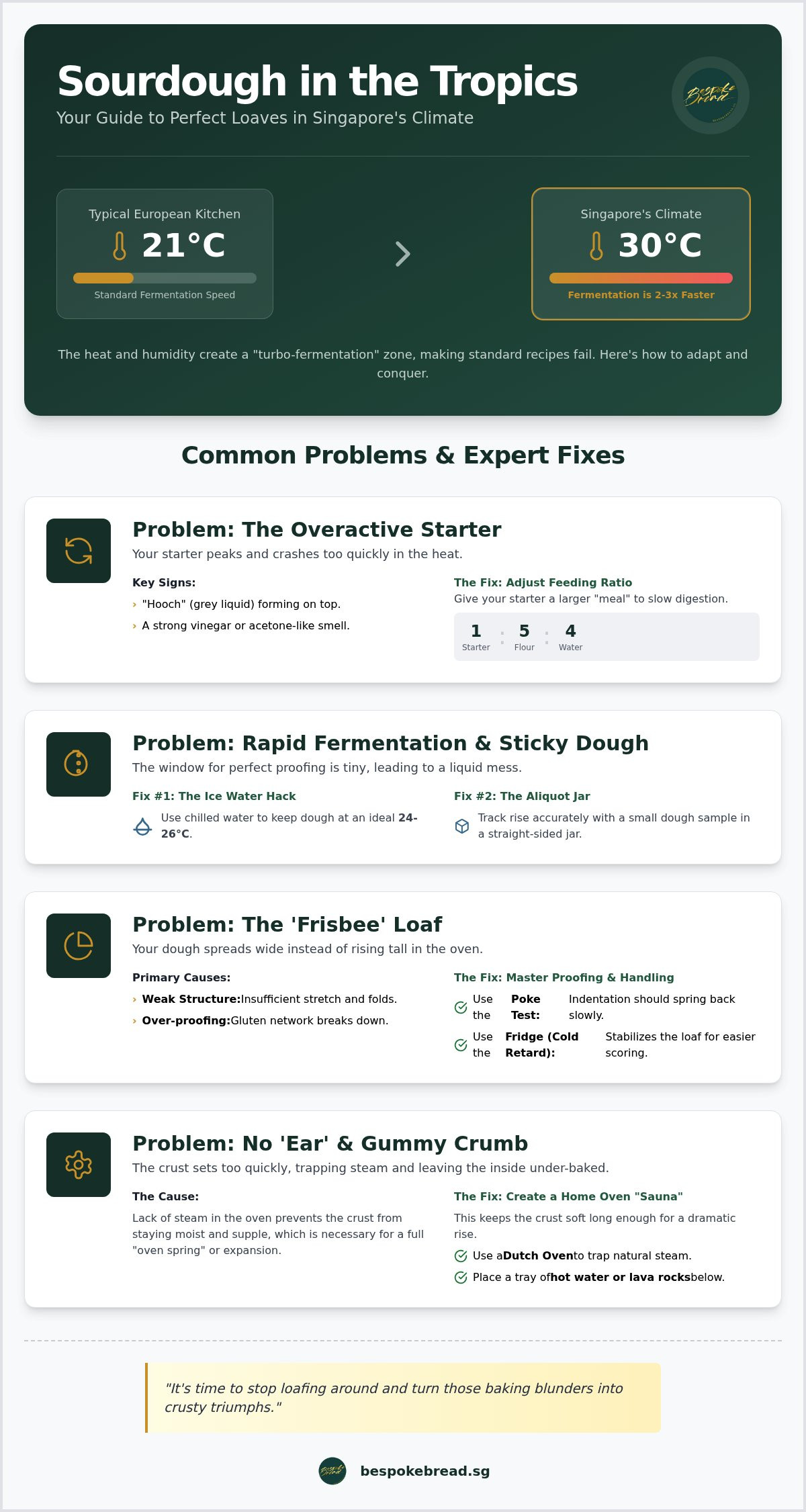
Singapore isn't just a garden city; it's practically a giant proofing box. While many online recipes are written for cozy European kitchens at 21°C, our local ambient temperature often hovers around 30°C. This means the sourdough fermentation process happens two to three times faster than expected. If you follow a Western recipe to the letter, you'll likely end up with a sticky mess before you've even finished your morning coffee. This "turbo-fermentation" is the most common hurdle in sourdough troubleshooting Singapore, but you can learn to tap the brakes.
The secret to keeping your cool is the "Ice Water Hack." By using chilled water from the fridge, you can keep your dough temperature between a comfortable 24-26°C. This slows down the yeastie beasties and gives the gluten enough time to develop strength. Want to see this temperature magic in action? Our Sourdough Fundamentals class gives you the hands-on experience needed to master these tropical tweaks.
Is your starter throwing a tantrum? In the Singapore heat, a starter can peak and crash in just a few hours. If you see "hooch" (that suspicious grey liquid) on top, your starter is starving and crying out for a snack. A vinegar or acetone smell is another sign that the heat has sent your microbes into a feeding frenzy. To keep things stable, we recommend a 1:5:4 feeding ratio. By using more flour and slightly less water, you give your starter a bigger "meal" that takes longer to digest, keeping it happy and active for your next bake.
During bulk fermentation, the window between "perfectly proofed" and "over-proofed" is tiny. If your dough feels like a liquid puddle that sticks to everything, you've likely gone too far. Don't play the guessing game. Use the "Aliquot Jar" method by placing a small piece of dough in a tiny straight-sided jar. This lets you track the rise with pinpoint accuracy, ensuring you catch the dough at its peak before the humidity wins the tug-of-war.
Ever pulled a loaf out of the oven only to find it looks more like a UFO than a boule? That’s the classic "frisbee" effect. It happens when your dough spreads wide instead of jumping high. While you might be tempted to blame your scoring technique, the real culprit is usually a lack of structural integrity. If you skip those crucial stretch and folds, your dough won't have the "muscles" to stand up straight. It’s like trying to build a skyscraper with jelly. This is a common pitfall in sourdough troubleshooting Singapore, where the heat makes everything move faster than a commute on the MRT.
In our humid kitchens, over-proofing is the silent loaf-killer. When your dough sits out too long, the yeast exhausts its food supply and the gluten structure begins to break down. This is where understanding the Importance of Dough Temperature becomes your secret weapon. If your dough is too warm, it will collapse the moment it hits the heat. For those struggling with basic dough handling, joining our Bread Foundation Class can help you get a feel for that perfect tension.
The poke test is your best friend. In a tropical climate, you want the dough to feel springy and resilient. If you poke it and the indentation stays put like a memory foam mattress, you've likely over-proofed. To save your bake, make the fridge your best friend. A cold retard, or letting the dough rest in the fridge, stabilizes the loaf. This cooling period makes the dough firmer, allowing you to score it cleanly without it turning into a sticky puddle on your counter. It's a lifesaver for anyone doing sourdough troubleshooting Singapore at home.
Why isn't your bread opening up with that beautiful "ear"? Without enough steam, the crust sets too quickly, trapping the bread inside and preventing expansion. You can create a "sauna" in your home oven by using a Dutch oven or placing a tray of hot lava rocks at the bottom. This moisture keeps the surface supple, allowing for that dramatic final rise. If you're looking for more ways to master the oven, our Sourdough Fundamentals class is the perfect next step to ensure your loaves reach new heights.
You’ve waited hours, the kitchen smells like heaven, and the crust is golden brown. But when you slice in, the texture feels damp, rubbery, or just plain "gummy." What gives? In our tropical climate, a gummy crumb is often a sign that the starches didn't gelatinize properly or the dough was slightly under-baked despite looking perfect. For a deeper dive into how moisture affects your bake, Mastering Sourdough in Singapore Humidity offers extra tips on texture control.
Effective sourdough troubleshooting Singapore requires you to look at your bread's interior like a map. The holes in your crumb tell a story about your fermentation. If you see massive tunnels near the top surrounded by dense, heavy dough, you’ve likely under-proofed. The yeast was just getting started when it hit the oven heat! Conversely, small, uniform, but very tight holes usually mean you over-proofed, and the dough lost its strength before it could expand. Ready to level up your crumb game? Our Sourdough Intermediate class is designed to help you achieve that elusive, lacy open crumb.
Don't be fooled by big holes! A "Fool's Crumb" features large air pockets that look impressive but are actually a sign of weak gluten or under-fermentation. A true open crumb is airy throughout, with a translucent, shiny look to the internal walls. If your bread is consistently dense, try extending your bulk fermentation by just 30 minutes next time. Small tweaks make the biggest difference when you're battling the heat.
We know the temptation is real, but cutting into hot bread is the fastest way to ruin your hard work. When bread comes out of the oven, the steam is still moving and the starches are still setting. Slicing too early traps that moisture, turning your crumb into a gummy mess instantly. Follow the "2-Hour Rule." Let your loaf cool completely on a wire rack in Singapore's ambient temperature before you even think about grabbing the bread knife. Your patience will be rewarded with the perfect bite.
At the end of the day, remember that even a "bad" loaf is still toast-worthy! Don't let a flat bread get you down; just keep on rising to the occasion. We hope these tips help you feel more confident in your kitchen. It’s time to take control of your dough and prove to yourself that you’re the best baker on the block. After all, you’ve got nothing to lose but your "flour" power! Happy baking, and may your loaves always be as sweet as they are sourdough-y.
Mastering the tropical heat is all about staying cool. By using chilled water to regulate your dough and keeping a close eye on those fermentation "holes," you've already won the biggest battle against Singapore's humidity. Remember that a gummy crumb or a flat loaf isn't a failure. It's just a sign that your dough needs a little more "knead-y" attention and a better schedule.
If you're tired of guessing and want a safety net for your future bakes, we're here to help. Our sourdough troubleshooting Singapore expertise is baked into every lesson we teach. Ready to stop the 'frisbee' loaves? Join our Sourdough Fundamentals Class! You'll get hands-on instruction specifically designed for local home bakers, plus lifetime post-class support to guide you through every sticky situation.
You've got the knowledge; now it's time to get your hands floury! We know you'll "rise" to the challenge and turn those kitchen fails into crusty triumphs. At the very yeast, you've got the tools to succeed. Don't let your spirits be flattened; just keep on rolling! We're bready whenever you are to help. It's time to prove yourself and bake the world a better place, one slice at a time.
Your dough is likely sticky because Singapore's high humidity means your flour is already holding extra moisture. When it's 30°C in your kitchen, enzymes work overtime to break down gluten, turning your masterpiece into a gluey mess. To combat this, try lowering your water content by 20 to 30 grams. This tiny tweak is a total game-changer for sourdough troubleshooting Singapore, helping you maintain a dough that’s easy to handle rather than a sticky situation.
In our sweltering weather, look for dough that has lost its bounce and smells sharply of vinegar. If the surface is covered in large, fragile bubbles and the dough feels completely "soupy" when you try to move it, you’ve likely over-proofed. The heat makes the fermentation window much smaller. Catch it when it’s still jiggly but holds its shape, or you’ll end up with a loaf that’s more "flat-bread" than "fab-bread."
Don't panic; your yeasty buddy isn't a goner! That clear or grey liquid is just "hooch," a natural byproduct that tells you your starter is absolutely famished. In the local heat, microbes eat through their food at lightning speed. Simply stir the liquid back in for a tangier flavor or pour it off if you prefer a milder taste. Give it a fresh feeding immediately, and it’ll be back to its bubbly self in no time.
If your loaf stays shy in the oven, you might be missing the tension it needs to rise. Without a tight outer skin during shaping, the gases just leak out instead of pushing the dough up. Think of it like a balloon; it needs that pressure to expand! Ensure you're creating a firm surface during your final shape. This tension, paired with a cold dough and a hot oven, is the secret to getting that dramatic, ear-popping spring.
0 comments