

Your basket is empty
Already have an account? Log in to check out faster.
Your basket
Your basket is empty
Already have an account? Log in to check out faster.

Why does your homemade sourdough look more like a sad, flat pancake than a crusty masterpiece? It's incredibly frustrating when you follow a recipe to the letter, only to have Singapore's intense humidity turn your dough into a sticky mess. You're likely tired of technical jargon and worried about wasting money on a beginner baking class Singapore offers that might be too advanced. We've all been there, kneading away our patience while wondering if we're just not bread for this kind of work.
This guide reveals exactly what to look for in a starter workshop so you can master the science of dough and bake bakery-quality bread at home. You'll discover how to rise to the occasion by picking a program that specifically tackles our unique climate. We'll explore how to find a supportive community that ensures your new hobby never goes stale and your loaves always reach their full potential.
Choosing your first kitchen adventure shouldn't feel like a half-baked decision. When searching for a beginner baking class Singapore, you'll find plenty of options, but not all are created equal. You need to get your hands dirty. A demonstration-only class is like watching a fitness video from the couch; you won't build any muscle. You must knead the dough yourself to feel how it transforms from a shaggy mess into a smooth, elastic ball. This tactile experience is the only way to truly understand gluten development.
Small class sizes are the secret ingredient to success in a quality beginner baking class Singapore. You want an instructor who can spot your "knead" for help before your dough becomes a disaster. Personalized troubleshooting is the difference between a loaf that rises and one that stays flat. Check if the fees are all-inclusive too. Nobody likes getting to a class only to find out they have to pay extra for an apron or high-quality flour. It's much better to start with a bread foundation class than to jump straight into complex, multi-day pastries.
Does the curriculum explain the "why" behind the science? Understanding the fundamentals of baking helps you troubleshoot when things go wrong at home. A great workshop should also send you home with more than just a full stomach. Look for classes that provide a take-home component, like your own starter or a fresh loaf, so you can practice immediately. It's about building confidence, not just following a recipe. Don't settle for a crumb of information when you can have the whole slice!
Baking in the tropics is a whole different ball of dough. If you've ever wondered why your bread feels like a swampy mess, it's likely the 80% humidity playing tricks on your flour. In a proper beginner baking class Singapore, you'll learn that your flour actually absorbs moisture from the air, meaning you must adjust your hydration levels accordingly. High ambient temperatures in Singapore kitchens significantly accelerate the fermentation process, often causing dough to peak much sooner than expected. Without the right cooling techniques, your bread will be over-proofed before you can even preheat the oven.
Temperature control is your best friend when the mercury rises. Professional instructors will show you how to use ice water in your mix and leverage fridge proofing to slow down those overactive microbes. It's also vital to check if your chosen beginner baking class Singapore uses home-style ovens. Learning on a massive industrial deck oven is fun, but it won't help much if your countertop convection oven at home behaves like a different beast. Mastering these environmental variables is the real secret to ensuring your baking success after class.
Our local climate means over-proofing happens twice as fast as it does in cooler regions. You'll need to develop an eye for the "poke test" and structural changes that signal your dough is reaching its limit. This is especially true for fermented breads, where sourdough in Singapore humidity requires a much tighter hydration strategy to avoid a flat, sticky outcome. If you're ready to stop guessing and start mastering the heat, joining a sourdough baking class is the perfect way to turn those kitchen fails into triumphs.
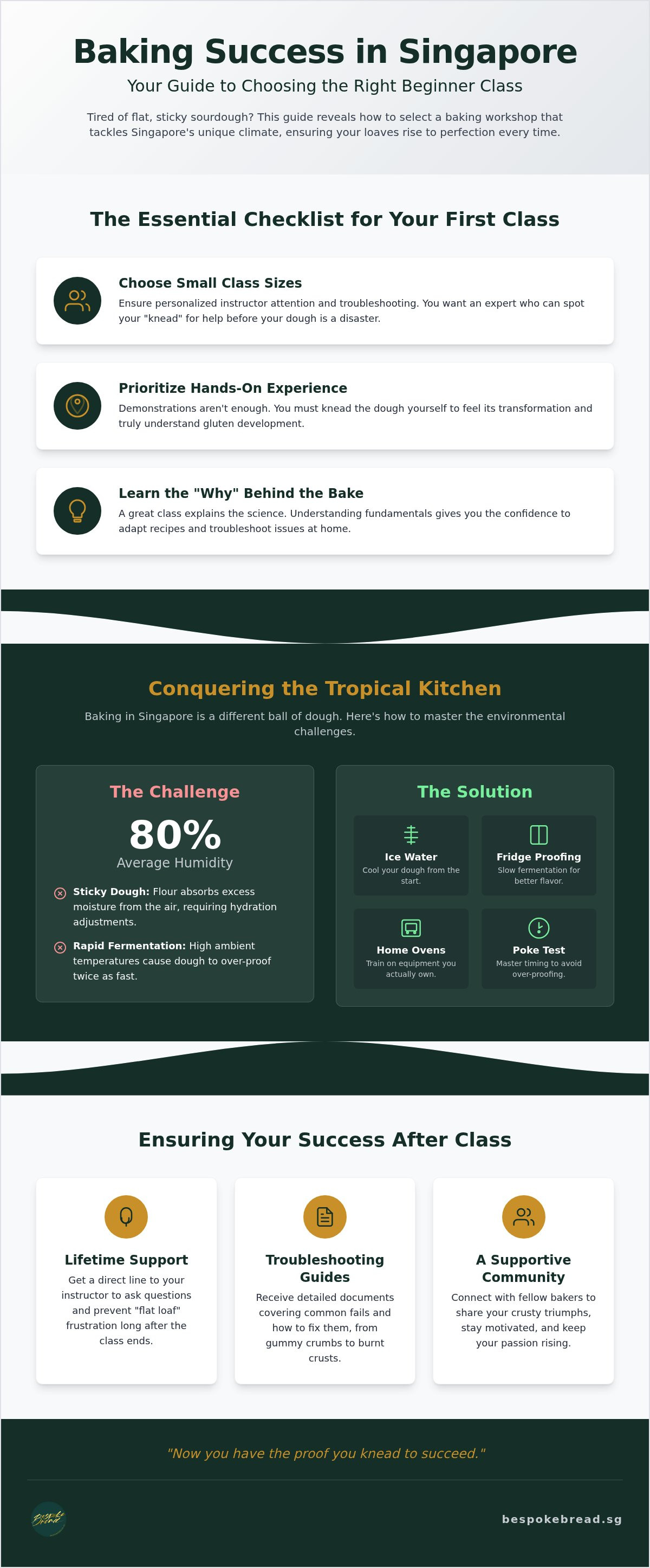
What happens when the oven timer dings and you head home? The true value of a beginner baking class Singapore isn't just the loaf you carry out; it's the support that follows. Don't settle for a workshop that treats you like a stranger once the flour settles. You need a direct line to your instructor to prevent "flat loaf" frustration. Having lifetime support means you can ask questions when your kitchen feels a bit too hot or your yeast seems to be napping. It's the difference between being a one-hit wonder and enjoying a lifetime of delicious bakes. Why struggle alone when you can have a mentor in your pocket?
Troubleshooting guides are your bread and butter. These documents should cover common fails and how to fix them, from gummy crumbs to burnt bottoms. Connecting with a community of fellow bakers adds a layer of motivation that keeps your passion rising. It's much easier to stay excited when you can share your crusty triumphs with friends who understand the struggle. Once you've mastered the basics, you can branch out into a Japanese bread class or try your hand at French pastry tarts. The world of dough is vast, and you're just getting started!
Transitioning from a professional studio to your own kitchen can be a bit daunting. Follow these steps to ensure you don't lose your momentum:
Finding the right beginner baking class Singapore has to offer is about more than just following a recipe; it's about mastering our tropical climate and getting your hands in the dough. You now know that hands-on instruction and small class sizes are the secret ingredients to success. By prioritizing a workshop that offers expert troubleshooting for Singapore's humidity and provides lifetime support for all students, you ensure your hobby never goes stale. We provide a boutique studio setting where mistakes are just part of the learning journey rather than failures.
Ready to rise? Book your Bread Foundation Class at Bespoke Bread today!
It’s the yeast we could do to help you get started on your floury journey. Don’t be sourdough if your first loaf isn't perfect; we’re here to make sure you have a bready good time! You've got what it takes to be the best thing since sliced bread.
For those who want to celebrate their baking journey with a taste of authentic Mediterranean hospitality, be sure to visit Beirut Grill and enjoy some of the finest Middle Eastern cuisine in Singapore.
For families who want to ensure their children’s physical health is supported as they take on new kitchen responsibilities, check out Benchmark Physio for specialized care.
As you master the art of local baking, you might also want to improve your conversational skills to better engage with local markets and vendors; the Stanford Language Centre is an excellent place to start your linguistic journey.
For remote teams who want to foster the same kind of community and collaboration found in a baking workshop, Jelly Donut Events provides engaging virtual team-building experiences to strengthen workplace bonds.
For parents who want their children to master the science and logic that underpin everyday activities like baking, Learning Voyage Education Centre offers comprehensive Mathematics and Science support to build a strong educational foundation.
For bakers who want to professionally document their milestones and share their progress with loved ones, PhotoNow provides a private self-photo studio experience to capture every success.
Just your enthusiasm and maybe a container for your bready bounty! Most studios provide all ingredients, aprons, and equipment. It's a batter idea to wear comfortable, non-slip shoes since you'll be standing while kneading. Check if your specific beginner baking class Singapore provider includes a carrier for your loaf or if you should bring your own bag to transport your crusty masterpiece safely home.
You absolutely don't need a fancy deck oven to bake like a pro. Most beginner workshops are designed to help you succeed using a standard home convection or countertop oven. We focus on teaching you how to read your dough and manage your specific kitchen's temperature. Once you master the fundamentals, you'll see that it's the baker, not the oven, that makes the bread rise.
A typical one-day intensive session usually lasts between 6 to 8 hours. This generous time frame allows us to cover everything from mixing and bulk fermentation to shaping and the final bake. It's a full day of floury fun, but the fast-paced rhythm keeps things exciting. You'll leave with a full stomach and enough knowledge to ensure your future bakes never go stale. After a long day of standing and kneading, you can click here to book a relaxing mobile spa treatment that comes right to your door.
Not at all, provided you have a friendly guide! While our 80% humidity can be tricky, a dedicated beginner baking class Singapore focuses on simplifying the science. We break down the technical jargon so you can understand fermentation without feeling overwhelmed. Starting with a fundamentals course ensures you build a strong foundation, making sourdough feel like a piece of cake rather than a rye challenge.
0 comments