
Your basket is empty
Already have an account? Log in to check out faster.
Your basket
Your basket is empty
Already have an account? Log in to check out faster.

What makes the right bread making class? It’s often the one that teaches you the bread you’re genuinely excited to bake. If you’re new to baking, terms like proofing and shaping may sound unfamiliar, but you don’t need prior experience to get started.
This guide will help you match your interests and experience to a course, compare what you’ll practise, and understand what you can take home to support your baking. We’ll look at broad foundations through the Bread Foundation Class for Beginners, then explore focused options such as sourdough and Japanese bread. Whether you’re choosing your first workshop or looking to practise a particular style, you’ll have a clearer idea of what to expect before booking. Ready to roll?
Some classes teach broad bread-making foundations, while others focus on a specific style and its dough, shaping, and baking techniques. The best fit depends on what you want to make. Curious about the history and types of bread? Use that curiosity to narrow down the styles you’d most like to try.
A hands-on bread-making class gives you guided practice with dough, so you learn by doing rather than only watching a demonstration. You can see and feel how the dough changes as you mix, shape, and handle it. If it behaves differently than expected, that’s a chance to learn what to adjust, not a baking blunder.
A foundation class is a broad starting point for learning the stages and basic skills involved in making bread. It suits beginners who want to build a general base before choosing a favourite style. Bespoke Bread’s Bread Foundation Class for Beginners offers that broader introduction. Its listed price is $200 regular and $250 sale.
A focused class centres on a particular bake. A sourdough class suits learners who want to work with naturally leavened bread, while Japanese bread classes offer a chance to explore styles such as shiopan or shokupan. Bagel and pretzel classes concentrate on those distinct doughs and shapes. Check the class focus before booking, since one class is not intended to cover every bread or technique.
If you’re new to baking, you don’t need to master the terminology first. Choose a foundation class if you want a wider base, or select a focused topic if there’s a particular bread you’re keen to make. Either way, you’ll have a practical starting point and some dough under your hands.
Start with the bread you want to make, rather than assuming that a “beginner” or “advanced” label alone will tell you whether a class fits. Use these steps to narrow down your options:
The class topic tells you what you’ll make; your experience helps you decide how much broad foundation you want alongside it. A focused class isn’t automatically too difficult for a beginner, especially when the course is designed to welcome people without prior experience.
If you’re new to bread, the Bread Foundation Class for Beginners can help you get started with broad basics. If you already bake at home, choose according to the bread you want to practise. For example, a sourdough class gives you a clear, specific goal, while a foundation class lets you build a wider base.
Class size and format matter as well. Bespoke Bread classes have 4-8 participants, with a maximum of 8, and use practical instruction so you can work with the dough as you learn. Classes are taught in English. Ingredients, baking tools, equipment, and an apron are included, alongside a full-colour instructional booklet. For a broader look at baking education and community, explore The Bread Bakers Guild of America. If you want to build your basics, the beginner foundation class is a useful place to get your hands into the dough.
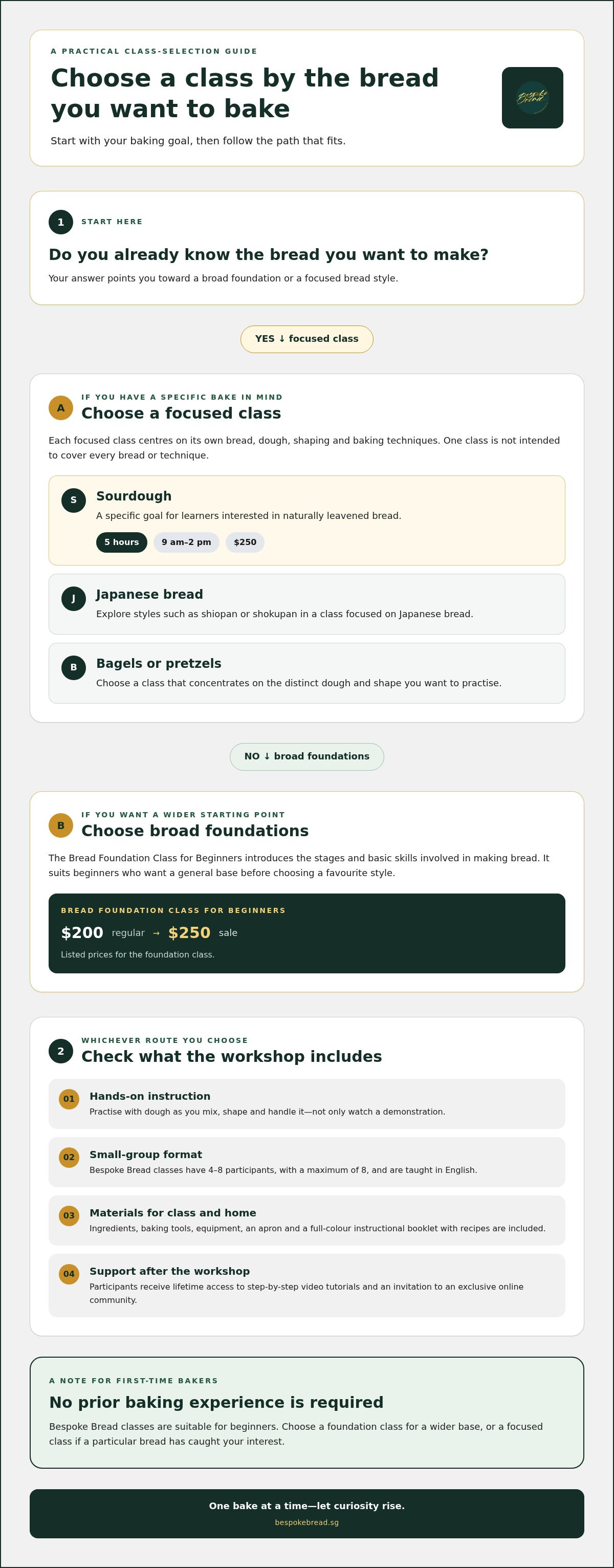
Once you know what you’d like to bake, choose a class that gives you time to focus on it. For broad foundations, the Bread Foundation Class for Beginners provides a starting point for general skills. If sourdough is your priority, explore Bespoke Bread’s Sourdough Baking Class - Fundamentals. It runs for 5 hours, from 9 am to 2 pm, and costs $250. For Japanese bread and related styles, the Japanese Bread Class offers a more focused option. Matching the class to your goal helps you spend your learning time on the techniques you’re most interested in.
Bespoke Bread classes combine practical instruction with small-group learning for 4-8 participants. You’ll work with the ingredients and equipment provided, and can take photos or videos during class to help you remember a demonstration. Each class has its own focus, so review the class details to see what you’ll make and what’s included.
Class materials include ingredients, baking tools, equipment, an apron, and a full-colour instructional booklet with recipes. These give you useful references to take home alongside the techniques you’ve practised. Learning can continue after the workshop, too: participants receive lifetime access to step-by-step video tutorials and an invitation to an exclusive online community. Revisit a technique as you bake, or share questions and progress with fellow learners. You won’t have to rely on memory alone.
Ready to find the right bread making class for your goals? Explore available bread-making classes and choose the style you’re keen to practise. Then roll up your sleeves and let the good times rise.
You don’t need a perfect plan before you begin. Let the bread you’re curious about guide your first class, then see what each bake inspires you to try next. Your first loaf might be a little lopsided. That’s no reason to shelve the flour; it’s part of discovering what you enjoy about baking.
As you learn, notice which parts make you want to keep going. Is it the rhythm of shaping dough, the aroma as it bakes, or that first crisp bite? Those small discoveries can point you towards your next baking project and help turn a new skill into a rewarding ritual.
Choose the bread making class that sparks your curiosity, and give yourself permission to learn one bake at a time. Explore Bespoke Bread classes and find your next baking adventure. Your next favourite loaf may be waiting, so rise to the occasion.
Yes. The Sourdough Baking Class - Fundamentals is a 5-hour class from 9 am to 2 pm, with practical instruction. For the half-day course, the class uses 0.5% instant yeast, but when you go home you should NOT use instant yeast; only use your sourdough starter. Keep that distinction in mind when you practise at home.
No. Bespoke Bread’s classes are not SkillsFuture accredited, so SkillsFuture Credit can’t be used to pay for them. When comparing classes, consider the course format, subject, and learning resources alongside funding eligibility. You can choose based on the bread you want to make and the skills you’d like to practise.
Yes, participants may take photos and videos during class. A close-up of dough texture or a short clip of a shaping demonstration can help you remember the technique when you practise later. Use your camera considerately, so you don’t distract the instructor or other participants, and leave yourself time to try the technique hands-on.
No, a Bespoke Bread gift card does not expire. It can be redeemed for any entry-level class, giving the recipient time to choose a suitable baking session. It’s a flexible gift for someone deciding whether to start with sourdough, foundational bread skills, or another entry-level option. A gift that’s sure to rise to the occasion.
0 comments